
USTP Panaon faculty participate in DOST workshop on technology readiness, innovation, and research commercialization
By Jenny M. Dela Cruz, Research Coordinator, USTP Panaon
Share:
Faculty members from the University of Science and Technology of Southern Philippines in Panaon, Misamis Occidental (USTP Panaon), participated in the “Advancing Research Impact: Training-Workshop on Technology Readiness Level (TRL), Innovation Readiness Level (IRL), and Commercialization Pathways” held on March 11–12, 2026, at N Hotel, Kauswagan, Cagayan de Oro City. The training was organized by the Department of Science and Technology Northern Mindanao (DOST NorMin) through its Technology Transfer and Entrepreneurship Collaboration and Harmonization of Growing Regional Opportunities on Wealth Creation (TECHGROW) program.
The workshop provided participants with a structured and practical understanding of how TRL and IRL frameworks can be used as decision-making tools in research development, innovation management, and technology transfer. The sessions also explored key aspects of intellectual property (IP) protection, industry collaboration, and technology commercialization strategies.
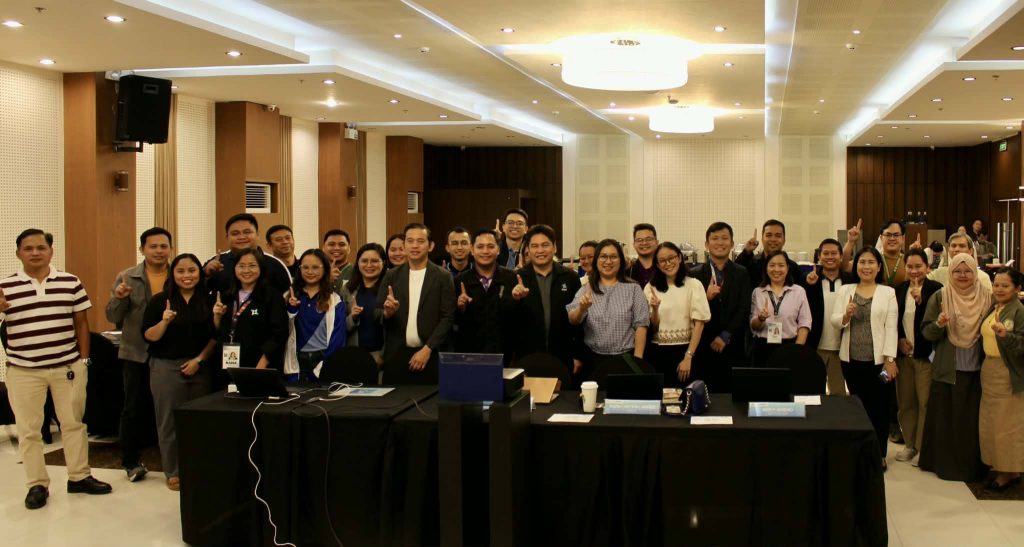
Representing USTP–Panaon Campus were Jenny M. Dela Cruz, Research Coordinator; Gizelle John M. Tacas-tacas, CET Coordinator; and Romulo S. Bomediano III, DIT Research Focal Person. Their participation highlights the campus’ continued commitment to strengthening its research innovation ecosystem and technology transfer initiatives.
On the first day, the training sessions featured experts who discussed key frameworks and strategies for advancing research toward commercialization. Mr. Keen P. Arsenio of the Board of Investments Philippines highlighted government tax incentives that support research-driven investments and innovation. Meanwhile, Ms. Maria Cristina L. Ibañez of UP SCALE NCR introduced the TRL and IRL frameworks, which help assess how research progresses from early-stage concepts to market-ready innovations. Building on these discussions, Ms. Mia Kaye Sabido of the UP SCALE NCR Innovation Hub emphasized the importance of research maturity and market readiness in bringing innovations to real-world application.
The concepts were then applied during a Workshop on Assessing Research Readiness, where participants evaluated research initiatives using the TRL and IRL frameworks. After signing Non-Disclosure Agreements (NDAs) to ensure research confidentiality, the USTP–Panaon team assessed CERTILINK, a student-developed web and mobile platform that automates certificate generation and request processing for local government units. The project won first place during the Regional Science and Technology Week 2025 pitching competition.
The assessment revealed that CERTILINK is currently at TRL Level 6 (Prototype System), IRL Level 7 (Full Testing of Systems and Products), and Market Readiness Level 4 (Small-Scale Stakeholder Campaign). Since TRL, IRL, and MRL each consist of nine levels, the team identified key steps needed to advance the technology toward full market readiness, including intellectual property protection and broader technology adoption.
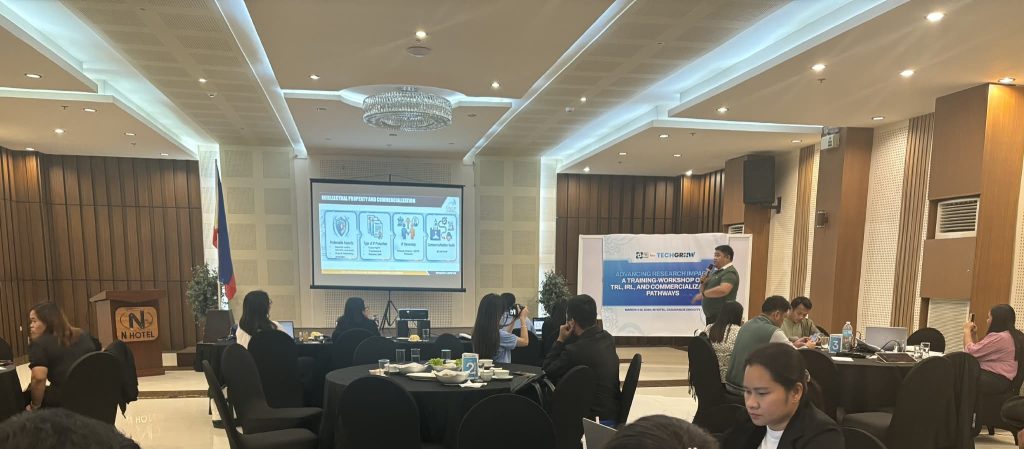
The second day focused on bridging research outputs with commercialization pathways. Ms. Sabido discussed aligning TRL and IRL with intellectual property protection strategies and research-to-market pathways, emphasizing that researchers should not only focus on generating publications, patents, and technological innovations but should also ensure that their outputs reach the market and benefit communities. Meanwhile, Ms. Ibañez presented the Triple Helix Model of Innovation, highlighting the complementary roles of research institutions, industry partners, and government in driving innovation:
- Academe – knowledge producer that generates research, technologies, and human capital
- Industry – economic driver that transforms knowledge into marketable products and services
- Government—regulator and enabler that provides funding, policies, and incentives to support innovation
Participants then engaged in another workshop where they developed a commercialization ecosystem map for their selected technologies, integrating TRL–IRL alignment, IP strategies, and multi-sector collaboration.
Continuing the assessment of CERTILINK, the USTP–Panaon team conducted an innovation and ecosystem analysis, identified potential risks and opportunities, and developed strategies for commercialization. The team also recognized the importance of securing IP protection as a key step in advancing the technology toward market readiness. The group’s workshop output was presented by Gizelle John M. Tacas-tacas, who shared the team’s analysis and proposed strategies. The speakers provided feedback emphasizing the need to secure IP protection while the project is still under development, particularly as the team continues to address suggestions and concerns from potential industry partners.
Overall, the training reinforced an important perspective for researchers: innovation should not stop at identifying research gaps in journals and publications. Instead, researchers are encouraged to engage with communities, understand real-world problems, and develop solutions that can be adopted and scaled. The workshop also underscored the importance of collaboration among academia, industry, and government in transforming research outputs into innovations that create economic value and societal impact.
Through initiatives like this training, USTP–Panaon continues to strengthen its role in innovation-driven research and technology commercialization, ensuring that academic research contributes meaningfully to regional and national development.